CRAFT & STRATEGY · 3 min read · September 1, 2026
Guarantee vs Warranty: What's the Difference? (With Real Examples)
A guarantee and a warranty get treated as interchangeable in everyday conversation. Most of the time that's harmless. It stops being harmless the moment a customer actually needs one. They expect it to mean something specific, and then discover the word they were told doesn't cover what they assumed it did.
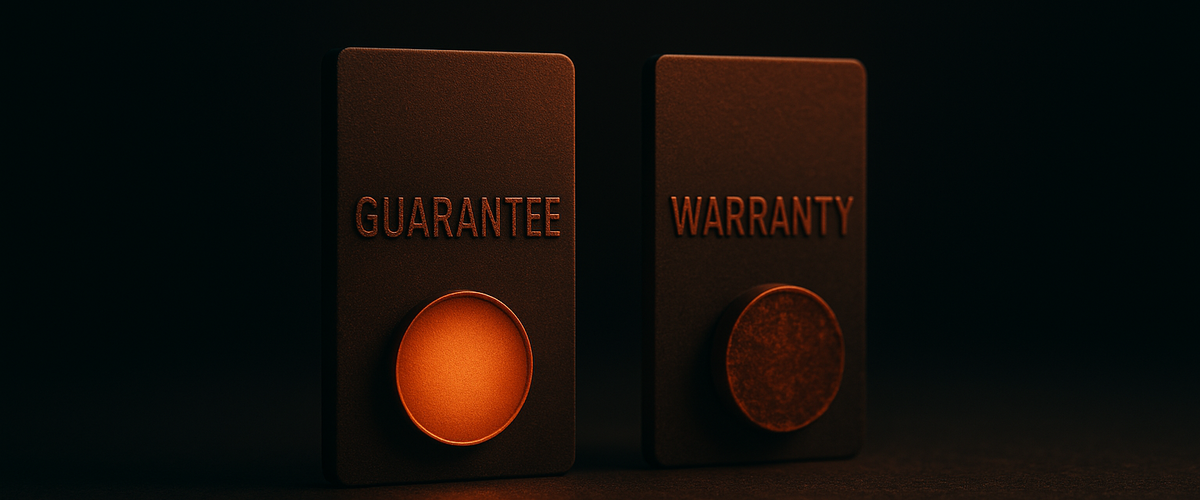
A warranty is narrow and specific. It typically covers defects in materials or workmanship, for a stated period, under stated conditions. A roof warranty might cover a manufacturing flaw in the shingles. It won't cover storm damage. That distinction is precise on purpose. It's usually written down formally. Sometimes it comes from a manufacturer, not the business itself.
A guarantee is broader. It's about the outcome as a whole. A satisfaction guarantee isn't limited to defects. It's a promise about the finished result, however that result gets defined. A landscaping guarantee might mean a full redo if a customer is unhappy with the result. That's true even if nothing was technically defective.
The confusion usually starts early. Both words get used to reassure a customer before any real problem exists. In that moment, the exact scope rarely gets questioned. It's only once something actually goes wrong that the difference matters. By then it's often too late to renegotiate what was actually promised.

A real example makes this easier to see than a definition does. A plumbing company might offer a one-year warranty on parts, covering manufacturing defects only. Separately, they might guarantee the job itself: if a leak isn't fixed on the first visit, they return at no charge until it is. Two different words. Two different promises. Both real, and both worth keeping separate in writing.
This is fixable with one simple habit. State plainly, in writing, what each term actually covers for your specific business. Not the dictionary definition. What it means here, for this service, in this situation. A guarantee that says "if you're not satisfied, we'll fix it at no cost within 30 days" leaves nothing to interpret. A warranty that says "materials only, one year, normal use" does the same.
Businesses that keep the two words vague aren't usually trying to mislead anyone. The vagueness just feels safer in the moment. A specific commitment can be pointed back to later, and that feels riskier. That same specificity is exactly what makes a customer trust it enough to act on it in the first place.
A quick way to check your own site: find every place "guarantee" or "warranty" appears. Ask whether a customer reading that one sentence would know exactly what happens if something goes wrong. If the answer is no, the sentence needs a rewrite. Not the customer's assumption.
The real difference between a guarantee and a warranty isn't really about the words. It's about whether a customer knows, before anything goes wrong, exactly what happens if it does.
Now that you know how a guarantee and a warranty actually differ, it's easier to write terms for your own business that a customer can actually rely on.
Let’s get started